New research into men’s experiences of domestic violence and abuse in Ireland
Posted on: 20 November 2026
Both men and women can be victims of Domestic Violence and Abuse (DVA), however a societal perception perpetuates that domestic abuse is predominantly an issue which affects women. Trinity College Dublin in conjunction with Men’s Aid Ireland obtained funding from Research Ireland to undertake new research to further the understanding of men in Ireland who are experiencing DVA, exploring how and when they seek help from their national helpline service.
The research was conducted by Dr Melissa Corbally and fellow researchers at the School of Nursing and Midwifery, Trinity College Dublin. This study used mixed methods of analysis to examine temporal trends, patterns of service utilisation, and potential seasonality of contacts to the service made between 1 January 2022 and 31 December 2024, as well as exploring men’s life stories of abuse.
Men’s Aid Ireland is a victim centric service supporting men and their families experiencing domestic violence and coercive control.
Key findings from the study
Over the three year period (2022-2024), there were 22,524 contacts to Men’s Aid from 4,532 clients by telephone, text and email. Of the 2,596 men who disclosed experiences of DVA, 71.3% were fathers, 45.8% were not living together with their partner, and 76.2% made multiple contacts with the service.
Emotional abuse affected 86.6%, psychological abuse was experienced by 71.4%, physical abuse was documented for 39.1% of victims, while coercive abuse was identified in 30.9%. Those who contacted the service multiple times were more likely to have experienced coercive abuse and sexual abuse.
Critical Life Events rather than season/calendar events influenced men’s lives and relationships. Such events were often described as turning points where abuse could no longer be ignored, tolerated, or rationalised. Most participants sought help at a time when they felt overwhelmed, isolated, or unable to cope with the impact of abuse and relationship breakdown.
Contact with Men’s Aid followed a period of deteriorating mental health and, in some cases, suicidal thoughts.
“I reached out to Men's Aid, and I went out to see a counsellor because I was so afraid for my health that I couldn't function properly. I had a suicidal thought.” - Male Participant
Participants described experiencing financial abuse, loss of autonomy, social isolation, surveillance, emotional manipulation, threats, and the use of children. Evidence of second wave abuse was also identified.
“I was afraid to go out and socialise with people, because she was very, very
possessive, like mad jealous." – Male Participant
“Controlled, financially controlled over who I can see, what I can do, what I can say"…“"She doesn't let me have access on my stuff. She's after changing passwords, PIN numbers on the cards, passwords on my e-mail, absolutely everything." - Male Participant
Children were described as a central mechanism of control and among the primary victims of both the abuse and the subsequent conflict. Feelings of shame, fear, self-doubt, and concerns about their children often delayed disclosure. Many men remained in abusive relationships because they feared losing contact with their children.
“She demanded the money. She's like, you want to see the child? Yeah, I'll meet you
over in the shopping centre. I need this, And then I'll bring the kid with me. And every time I was going there waiting and she would never show up”. – Male Participant
Recommendations
The study suggests that:
• Continuity of service support is important as most male victims contact the service on multiple occasions over time.
• Service provision should continue to pay particular attention to male victims who contact services frequently over time.
• Service provision should continue to pay particular attention to fathers who may experience additional challenges over time.
• Expansion of services access to improve geographical accessibility to male victims nationally would be beneficial.
• Increased national awareness of men’s domestic abuse services would be helpful.
• Assigning a caller ID or reference code to anonymous callers would be useful in enabling the potential development of a ‘client’ profile for men to benefit from continuity of service.
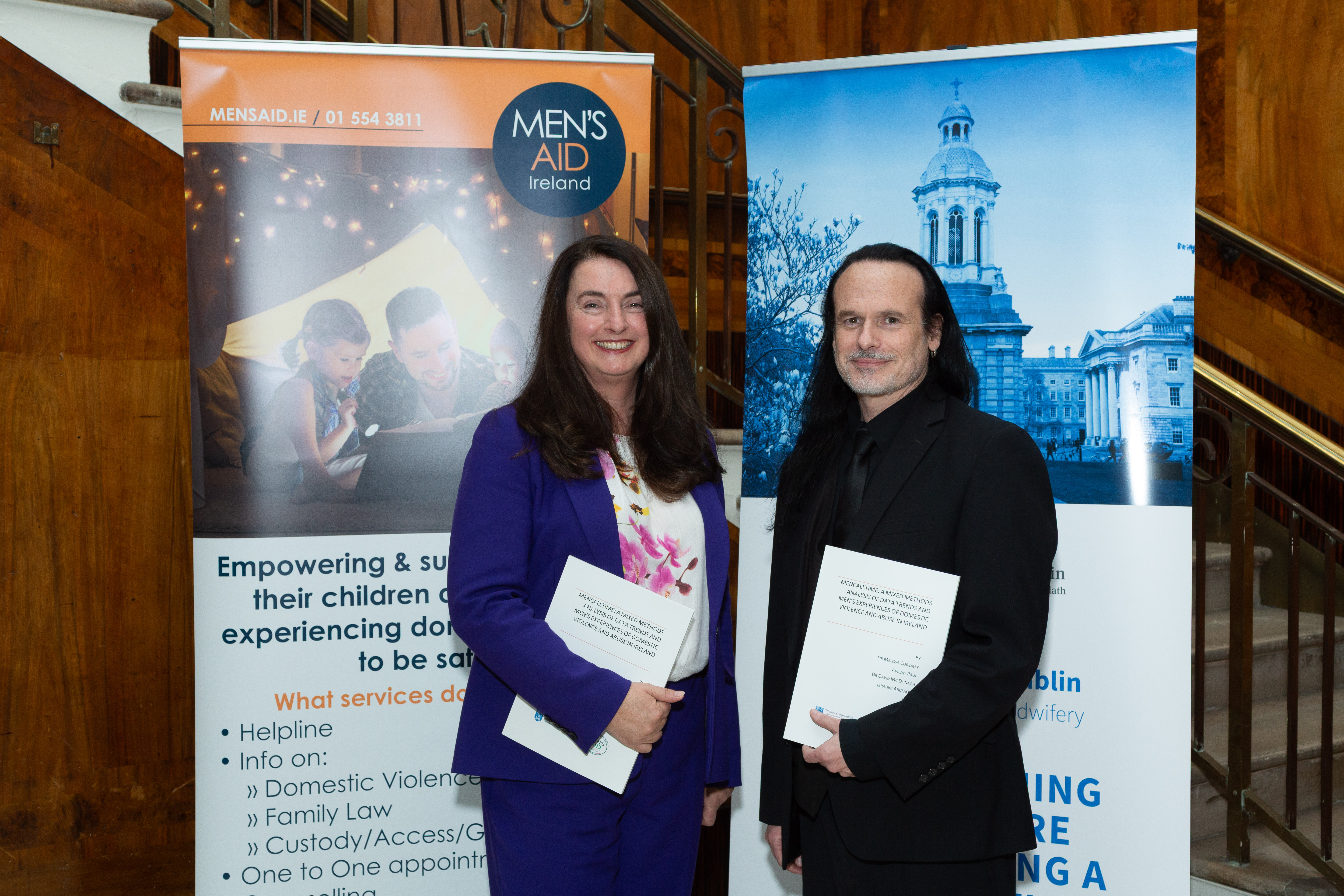
Shane Kelly, CEO, Men’s Aid Ireland, said: “This research provides an important evidence base for what we hear every day from men who contact our service: domestic abuse can take many forms, can continue over a long period, and can have a profound impact on victims, their children and their wider lives.
"The findings reinforce the importance of specialist, accessible and continuous support, particularly for fathers and for men who may need to reach out more than once before they are ready or able to make changes. Men’s Aid is proud to have worked with Trinity College Dublin on this research. It will help inform our services, national policy and a more inclusive response in which every victim of domestic abuse is recognised, heard and supported.”
Dr. Melissa Corbally said: “This study is important as it represents the largest retrospective analysis of call data ever undertaken on a men’s helpline in Ireland. This analysis, coupled with real life perspectives of men who have experienced abuse provide extensive insight into domestic abuse victimisation for men and highlight the complexities for men in Ireland who struggle with recognising abuse and seeking help. This study highlights the crucial role of helpline and support services as well as providing evidence to inform future domestic abuse service provision.”
The report was launched on International Men's Day, marked annually on 19 November.
Media Contact:
Ruth McAvinia | Research Communications Manager (Health Sciences) | rmcavini@tcd.ie